
Introduction: Bihar – The Birthplace of World’s Finest Makhana
When people ask why Bihar produces the best makhana, the answer lies in a rare combination of geography, tradition, and human expertise. For centuries, Bihar—especially the Mithila region—has been the natural home of makhana cultivation. No other place in the world matches Bihar’s ability to grow, process, and deliver makhana of such superior taste, texture, and nutritional quality.
Unique Wetland Ecosystem of Bihar
One of the biggest reasons Bihar produces the best makhana or lotus seeds is its natural wetland ecosystem. Makhana grows in shallow freshwater ponds, lakes, and marshlands. Northern Bihar has thousands of such water bodies, enriched by rivers like the Kosi, Gandak, and Bagmati.

These wetlands provide:
- Stable water temperature
- Mineral-rich soil
- Natural nutrients without chemical inputs
This environment is extremely difficult to replicate elsewhere, giving Bihar makhana a natural advantage in size, whiteness, and crunch.
Quick Answer:
Bihar produces the best makhana in the world due to its unique wetland ecosystem, fertile soil, ideal climate, centuries-old traditional processing methods, skilled farming communities, and GI-tag recognition that ensures superior quality and authenticity.
Want to learn more about makhana, explore our detailed guides below:
- What Is Makhana?
- Makhana Cultivation in India
- Traditional Makhana Processing in Bihar
- Makhana Industry & Business
- Global Journey of Makhana: From Bihar to the World
Ideal Climate for Makhana Cultivation
Bihar’s climate plays a crucial role in producing the best quality makhana. The region experiences:
- Warm summers for seed development
- Moderate rainfall during growth stages
- Mild winters for harvesting and drying
This climate cycle perfectly matches the makhana plant’s biological needs, resulting in uniform popping, better expansion, and superior taste.
Traditional Knowledge Passed Through Generations
Another major reason why Bihar produces the best makhana is traditional farming knowledge. Local communities, especially the Mallaha (fishing) community, have cultivated makhana for generations.
They understand:
- The right seed selection
- Correct harvesting time
- Traditional roasting and popping techniques
This deep-rooted expertise cannot be replaced by machines or modern shortcuts.
Labor-Intensive Traditional Processing
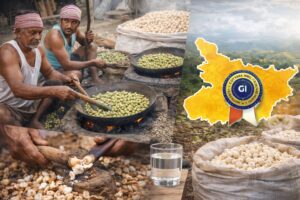
Unlike many crops, makhana processing is entirely manual and highly skilled. After harvesting, the seeds go through:
- Sun drying
- Roasting in clay pans
- Hand popping using wooden hammers
- Careful grading and sorting
This traditional processing method is unique to Bihar and is one of the biggest reasons Bihar produces the best makhana with:
- Better expansion ratio
- Lighter texture
- Higher nutritional retention
GI Tag Recognition: Proof of Authenticity
Bihar makhana has received Geographical Indication (GI) tag status. This officially recognizes:
- Its unique origin
- Superior quality
- Traditional production methods
The GI tag ensures that authentic Bihar makhana stands apart from inferior varieties grown in other regions.
Higher Nutritional Value
Studies and consumer experience consistently show that Bihar makhana is:
- Higher in protein
- Lower in fat
- Richer in minerals like calcium and magnesium
The natural cultivation and slow processing preserve nutrients, making it a preferred choice for health-conscious consumers.
Strong Domestic & Global Demand
Because Bihar produces the best makhana, it dominates:
- Indian premium markets
- Export markets in the USA, Europe, Middle East, and Asia
Global buyers specifically ask for “Bihar-origin makhana” due to its consistent quality and reputation.
Why Other States Can’t Match Bihar
Although makhana is now grown experimentally in other states, they lack:
- Natural wetlands
- Skilled labor
- Traditional processing knowledge
As a result, the taste, size, and quality do not match Bihar makhana.
Conclusion: Bihar’s Natural Monopoly in Makhana
In conclusion, Bihar produces the best makhana because of a rare combination of nature and tradition. From wetlands and climate to skilled communities and GI protection, Bihar holds an unmatched position in the global makhana industry. This is why Bihar is, and will remain, the undisputed heart of the world’s finest makhana.
Q1. Why is Bihar famous for makhana?
Ans: Bihar is famous for makhana because of its ideal wetland ecosystem, traditional farming knowledge, and superior processing methods.
Q2. Which region of Bihar produces the best makhana?
Ans: The Mithila region of North Bihar is known for producing the highest quality makhana.
Q3. Does Bihar makhana have a GI tag?
Ans: Yes, Bihar makhana has received a Geographical Indication (GI) tag.
Q4. Is Bihar makhana better than makhana from other states?
Ans: Yes, Bihar makhana is considered superior in size, taste, texture, and nutrition.
Q5. Is Bihar the largest producer of makhana in India?
Ans: Yes, Bihar produces more than 80–90% of India’s total makhana.
